Volume 4: World Wide Web
What if a company website could show the world behind the product?

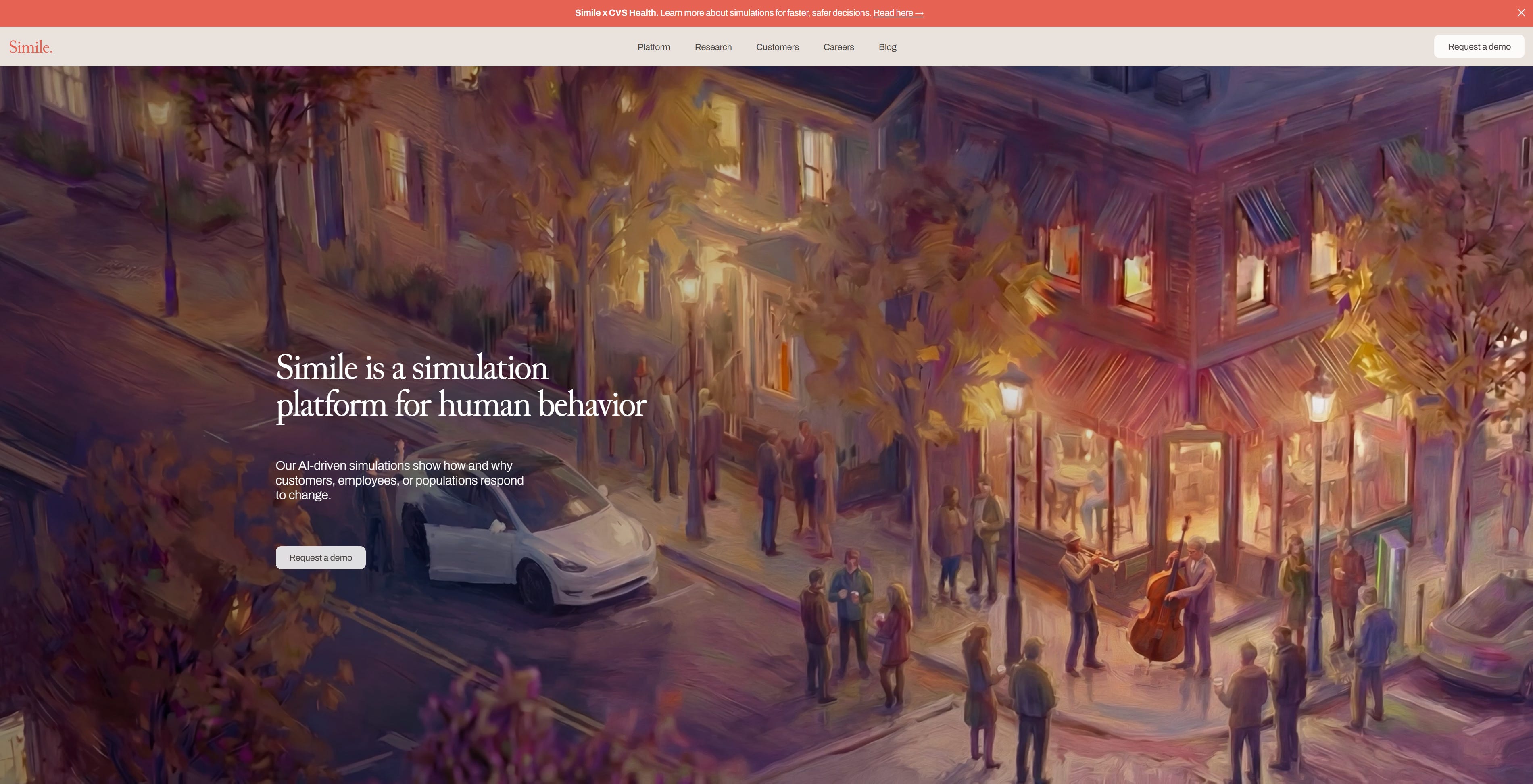
I’ve done a very deep dive tonight on an AI company called Simile, which is basically trying to build AI simulations of society in order to better understand and predict human behavior. There are lots of fascinating things about the company and one of the co-founders, Joon Sung Park, but what most caught my eye as I was hunting around was this job description they have up right now for a Video Game Designer:
Here’s the problem. Every AI company website is the same: a hero image, a tagline, some customer logos, and “Book a Demo.” We build living worlds for a living, so our website should be a place for exploration.
We’ll give you a town full of simulated people. You’ll turn it into a living, breathing place for people to discover. None of this exists yet, but you’ll build it. That’s the job: build us a website that feels like Smallville. Populate it. Make it move. Make the people who land on it want to stay, play with it, and send it to someone else.
This feels important far beyond one AI company.
A lot of companies working on the future are still using websites built for the past. They are trying to explain complex, invisible, high-stakes systems through static pages and familiar conversion patterns. But the work they do often lives somewhere else entirely: in models, behaviors, infrastructure, decisions, networks, scenarios, risks, timelines, and possible futures.
For those companies, the website has a bigger job than communicating what they do. It has to make the world they are building feel legible.
This is especially true for climate, energy, and infrastructure companies where so much of the value is abstract until you can see it in context.
But what if a website could show the world these companies are making possible?
A clean energy company could let visitors move through a neighborhood as it responds to a storm, watching solar, storage, and microgrids work together in real time. A company selling faster interconnection or behind-the-meter power could let someone drop a data center or factory onto a map and watch the queue years stack up, then show what changes when onsite generation or storage enters the picture. This is one of the most talked-about bottlenecks in energy right now, and almost nobody has made it visceral.
A water infrastructure company could let visitors follow a drop of water through a hotel, factory, farm, or small community. Where does the water come from? What happens after it is used? What can be treated, reused, discharged, or recovered? Most people know drought, scarcity, compliance, and cost are problems, but they do not always have a clear picture of the water system underneath. A website could make that system visible.
Companies need to think beyond the page and what’s been done up until now. And what I like about Simile’s approach is that it feels novel, but also sort of obvious once you see it. They build simulations of human behavior. Their research lives in worlds, agents, movement, choices, and emergence. There is an artist’s instinct in the ask, too. No surprise, maybe, since co-founder Joon Sung Park describes himself as a “semi-active oil painter/photographer.” Don’t just describe the thing. Create a space people can enter. So of course the website should not just explain the world they are building. It should let people move through one.
The most interesting websites of the next decade may feel less like digital brochures and more like tiny worlds. They will not just tell us what a company does. They will let us experience the logic of the company’s future.
This matters because the future is hard to believe in when it only appears as language.
A better website can make an abstract idea tangible. It can help people understand what changes, what improves, and why it matters. It can turn a technical product into a felt experience. It can give people a place to rehearse belief before the future fully arrives.
For companies building new systems, that may be the real opportunity: stop treating the website as the final stop in the sales funnel and start treating it as the first inhabitable version of the world you are trying to create.
Show me this future! Show me how it sounds, what it feels like, what becomes easier, safer, stranger, more possible. Don’t just tell me the technology works. Let me see the world where it has already become part of daily life.
I would be thrilled to build that website.
P.S.
I recently wrote about this from another angle for DG+, a climate and clean energy agency where I work as Creative Director. That piece is about sameness: how many companies building very different futures still end up with branding that looks and sounds almost exactly the same. This kind of thinking from Simile is exactly what I wish more future-facing companies would try.
P.S.S. Sorry I am not as consistent with writing. If you are new around here (hell, even if you are old around here), I just want to say thank you for subscribing and staying despite my only posting a few times a year. I really do hope to write more frequently this year!